
Promised as a defining pillar of his 2024 election campaign, Keir Starmer’s vow to dismantle people-smuggling gangs and curb small boat crossings across the Channel now lies in ruins. With record arrivals, public disillusionment, and political backlash mounting, the Prime Minister faces damning questions over competence, credibility, and a growing list of broken promises.
Campaign Rhetoric vs. Reality
During the campaign, slogan-happy Starmer made a bold pledge to “Smash the Gangs” facilitating illegal small-boat crossings of the English Channel. This slogan, a Labour answer to the Conservatives’ “stop the boats” mantra, promised a tougher approach to people-smuggling. Starmer derided the outgoing Tory government’s measures – notably calling the Rwanda deportation scheme a costly failure – and vowed that a Labour government would take “tough but pragmatic” action instead.
His manifesto outlined a new Border Security Command (BSC) staffed with hundreds of specialist officers, funded by scrapping the Rwanda plan, to “pursue, disrupt and arrest” those running the “vile trade” of people-smuggling. Starmer promised to treat these smugglers like terrorists and “turn the page on Westminster’s ‘talk tough, do nothing’ culture”, implicitly contrasting himself with his political predecessors.
As Opposition Leader, Starmer even floated the notion of striking a “quid pro quo” deal with the EU: The UK would accept quotas of asylum seekers from Europe in return for being able to swiftly return those arriving illegally. He declared his government, if elected, would be “twice as ruthless” as the Tories in breaking the smuggling networks.
Such rhetoric signalled a hard line, appealing to voters fed up with daily boat landings on England’s southern shores. However, nearly a year on, the gap between Starmer’s campaign talk and the reality under his premiership has become glaring. The promise to “Smash the Gangs” is widely seen as unfulfilled, with illegal Channel crossings continuing at high levels and the criminal networks seemingly undeterred.
Channel Crossings Continue Unabated
Far from disappearing, small-boat crossings have persisted – even increased – since Starmer took office. By late 2024, it was evident the crisis was nowhere near “smashed.” The winter months, once expected to slow crossings, saw hundreds of people still attempting the perilous journey. On Christmas Day 2024 alone, 451 migrants arrived in Kent via small boats, followed by 407 on Boxing Day.
Tragically, the year 2024 also became the deadliest yet in the Channel, with at least 60 migrants perishing in the attempt – five times more than the previous year. French officials described the situation as “crossing after crossing, without any let-up”, underscoring that the promised turnaround had not materialised.
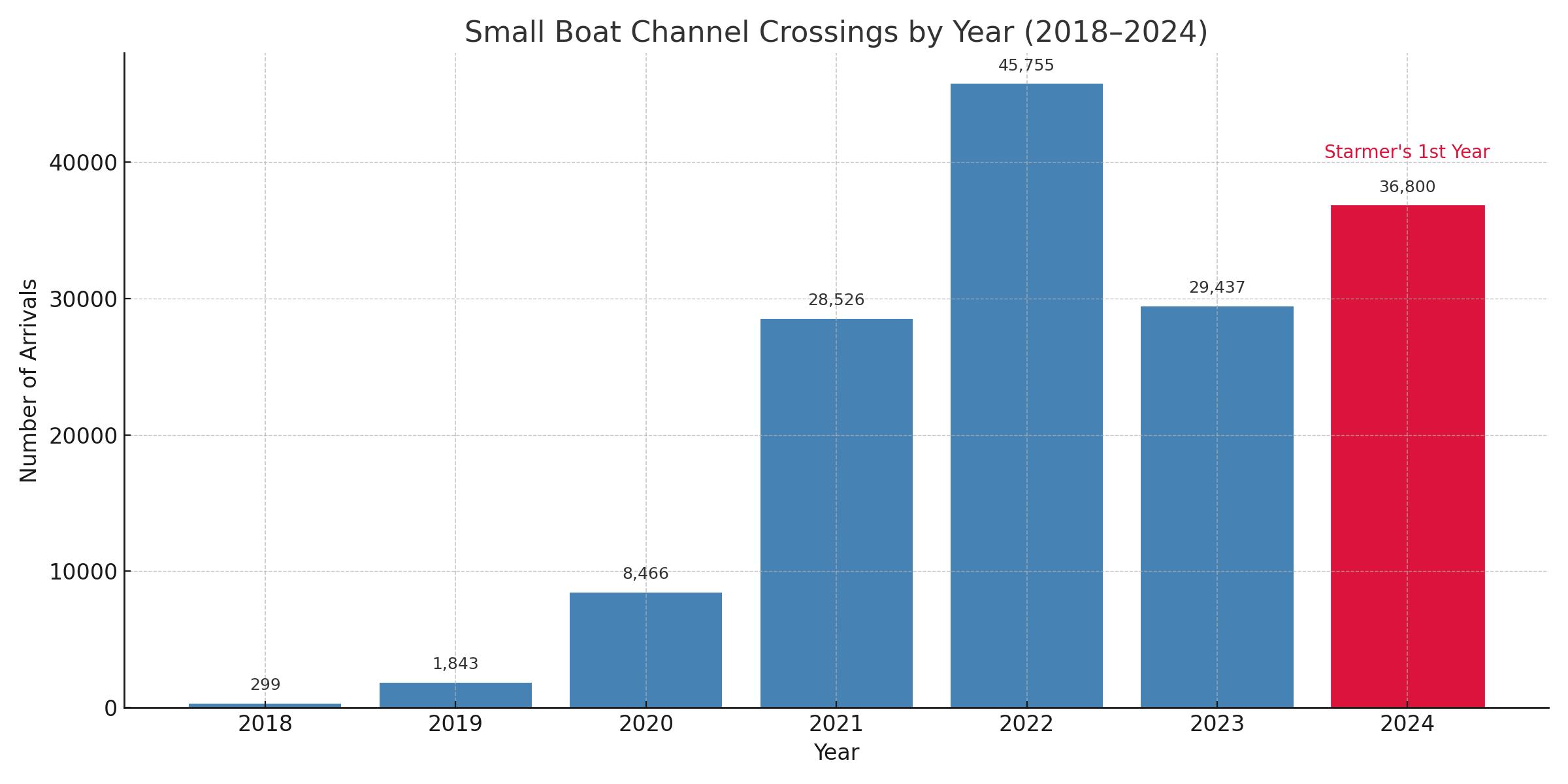
Statistics tell a sobering story. In the first six months of 2024, while Starmer was still campaigning, a record 12,901 people crossed the Channel – the highest January–June total ever, exceeding even the 2022 mid-year peak. Once Labour assumed power mid-year, the trend did not reverse. An estimated 23,000 individuals arrived via small boats during the second half of 2024 under Starmer’s watch. That puts the full-year tally around 36,800 – roughly 25% higher than the previous year’s total (29,437 in 2023). In fact, 2024’s total illegal boat arrivals were on par with the record-setting levels of 2022, when just under 45,800 made the journey. Any temporary dip in 2023 has been erased by a renewed surge (see chart below).
Dozens of overloaded dinghies continued to land on English beaches each week, making a mockery of the “smash the gangs” pledge.The relentless numbers have left Starmer’s government struggling to claim any progress. Home Secretary Yvette Cooper admitted it was “no comfort” to see crossings still running so high. Indeed, while 2024’s final total remained slightly below the 2022 peak, it was significantly higher than when Starmer took office – a clear indication that the flow of illegal migration has not been stemmed.
Early 2025 offered little respite. Hundreds more people arrived in the first weeks of January, exploiting every window of calm weather. On one mid-January Saturday, 801 migrants crossed in 14 boats – the highest daily figure since Labour came to power (and the second-highest for the entire crisis) according to official briefings, underscoring how unabated the situation remains. For all of Starmer’s tough talk, the Channel migrant crisis endures at essentially the same scale, if not worse.
Government Measures: Bold Plans, Meager Results
To fulfill his pledge, Starmer’s government did move quickly on certain fronts. One of his first acts in office was to scrap the Conservatives’ much-maligned Rwanda scheme, halting the plan to deport asylum seekers to East Africa (a policy that had consumed over £300 million without a single flight taking off). The funds saved were redirected to Starmer’s flagship Border Security Command. The BSC was established as promised, combining officers from the National Crime Agency, police, and MI5; armed with new powers to hunt down smuggling networks.
Funding for the BSC was doubled to £150 million over two years, with an influx of hundreds of new investigators and intelligence officers backed by cutting-edge surveillance tech. Starmer announced that Britain would “treat people smugglers like terrorists,” applying counter-terrorism tactics to dismantle their operations. Additional resources were pledged to Europol and Interpol, and Britain began drafting a new sanctions regime to freeze traffickers’ assets internationally.
.On paper, these measures signaled a major crackdown. In practice, however, their impact has been limited so far. The government boasts that it has removed 16,400 “illegal migrants” from Britain since July – the fastest pace of enforced removals since 2018.
But many of those deportations involved individuals already residing in the UK (including foreign convicts), not just recent Channel arrivals. When it comes to the small-boat gangs themselves, there have been some arrests and international police stings, yet no evidence of a crippling blow to their business model. Smuggling kingpins remain elusive; as one immigration expert noted, these are “decentralised” networks – there’s not some big boss you can smash”. Gangs adapt quickly to enforcement pressure: when patrols increased on one French beach, launch points simply shifted elsewhere along the coast.
The promised new bilateral agreements have also stalled – the much-touted migrant returns deal with the EU has yet to materialize, as European partners remain reluctant and Brexit-era mistrust lingers. Crucially, critics say Starmer’s strategy has focused on symptoms (the boats and gangs) while ignoring root causes and safety valves. Safe and legal asylum routes – which many believe would reduce demand for smugglers – have not been meaningfully expanded. A Home Office insider pointed out that smugglers are effectively filling a void, “offering an illegal service to those in need” because safer alternatives to reach the UK are absent. Yet the new government, much like the last, has been silent on creating humanitarian corridors or refugee visas. With Britain still refusing asylum applications from abroad, desperate migrants continue to see no choice but to pay gang facilitators. In short, Starmer’s measures – more raids, more agents, more patrols – have yielded only modest outcomes. The flow of boats has not “stopped,” and the gangs have not been “smashed.” Instead, the criminal enterprise has proven resilient, adjusting tactics and exploiting every loophole as quickly as the UK plugs one.
Public and Political Backlash
As the Channel crisis grinds on, public frustration and political blowback have been intense. Starmer had made “smashing” the smuggling gangs a signature pledge, raising expectations that he could succeed where his predecessors failed. The perceived failure to deliver has now become a major vulnerability for his administration. Opinion polls show that confidence in Starmer’s handling of immigration has cratered. One recent survey found his personal rating for “representing what ordinary people think” had plummeted from slightly positive at the time of the election to –39% today. Voters in coastal communities and beyond voice a sense of betrayal, noting that despite a change in government, the scenes of overcrowded dinghies landing on British shores remain familiar nightly news fare.
Perhaps most striking, the ongoing boat crossings have fueled a rapid rise in support for Nigel Farage’s hard-right Reform UK party. Reform campaigned on an even harsher approach – from physically turning back boats to zero asylum for illegal entrants – and many disillusioned voters are now flocking to this banner. In an early 2025 poll, Reform UK surged to 26%, statistically tied with Labour’s 27%, while the Conservatives fell to third place. Immigration and border control were by far the top reasons cited by those switching to Reform.
These voters see Starmer’s government as having talked big but delivered “open borders” in practice. Right-wing tabloids and opponents have seized on images of migrants still streaming into Dover to mock the “smash the gangs” slogan as empty words. Conservative MPs gleefully remind Starmer of his own campaign ads and ask, “Where is the progress?”
Pressure is mounting within the Labour Party as well. Dozens of Labour MPs in marginal constituencies – especially those where Reform UK is encroaching – have formed a caucus urging Downing Street to “get a grip” on Channel crossings. They warn that unless the government shows tangible results soon, it risks a severe backlash at the next election.
This panic inside Labour, combined with scathing criticism from the opposition, has created a rare phenomenon: Starmer’s pledge is being condemned from all sides. Even voices on the left, including refugee charities and some Labour members, had criticised the “un-British” rhetoric of treating asylum as a security threat. Now they fault Starmer not only for a morally dubious approach, but an ineffective one at that. The public mood is one of disappointment and cynicism – a sense that yet again a politician promised to fix a crisis, only to deliver more of the status quo.
Experts: “Tough Talk” Isn’t Enough
Immigration and security experts largely agree that Starmer’s strategy has not addressed deeper issues driving the Channel crossings. Enver Solomon, chief executive of the Refugee Council, argues that “‘smash the gangs’ is just Keir Starmer’s version of ‘stop the boats’”, and predicts it “won’t solve the migrant crisis”. Solomon notes that Starmer has emulated Tony Blair’s 1990s “tough on crime” posture – going after criminal gangs hard – but without equal emphasis on being “tough on the causes” of irregular migration.
Those causes include war, persecution, and poverty which drive people to flee, as well as the lack of safe asylum routes into the UK. As Solomon and others point out, most refugees do not want to leave their regions – about 70% remain in countries neighbouring their homeland – and will only embark on dangerous journeys if they feel no alternative.
By focusing narrowly on enforcement, the UK government may be missing the larger picture. Indeed, every crackdown so far has seen smugglers respond by altering tactics – using more dangerous launch sites, packing even more people onto boats – leading to higher risks and death tolls.
Migration analysts from the University of Oxford and think tanks like IPPR echo these sentiments. Researcher Ben Brindle notes that the previous Conservative government was “also very hot on enforcement, so it’s not a new direction” – Labour has mainly changed the branding of the policy, not the substance. Marley Morris of IPPR warns that without opening new legal pathways to claim asylum, “continuing high numbers” of boat crossings are likely, no matter how many gang leaders are arrested.
Home Office officials privately acknowledge that border control is already tightly enforced, yet “the gangs are very adaptive and keep outsmarting most provisions”. This cat-and-mouse dynamic suggests there is no quick fix.
Starmer’s approach, essentially a law-and-order tactic, was never guaranteed to stop thousands of determined migrants dispersed across French beaches. The business model of smuggling – often fuelled by human desperation but, sometimes, financial nirvana – has endured countless police operations across Europe. Experts, therefore, call for a broader strategy: expanded safe resettlement schemes, faster asylum processing to remove backlogs, and international initiatives to address conflicts and instability that generate refugees. So far, Starmer has shown little inclination toward such holistic solutions, sticking instead to a “smash and grab”philosophy that, according to many specialists, has yielded more soundbites than successes.
New Strategy or Repackaged Old Tactics?
A critical question is whether Starmer’s “Smash the Gangs” agenda ever truly represented a departure from past policies. Despite the change in slogan, much of Labour’s approach builds on the framework left by the Conservatives – with a heavier emphasis on policing but ultimately similar goals.
The Conservative government under Rishi Sunak had already ramped up covert operations with France, deployed drones and extra patrols on beaches, and passed draconian laws (like the 2023 Illegal Migration Act) to deter crossings. Starmer scrapped some of the more controversial Tory elements – most notably the Rwanda deportation plan and the ban on asylum claims for boat arrivals – which won him some initial praise from human rights groups.
But in doing so, he removed deterrence tools without yet securing effective replacements. Brexit had taken away the EU returns agreement (the Dublin regulation), meaning the UK currently has “few options” to send back unsuccessful asylum seekers. Starmer hoped to negotiate new returns deals and a security pact with Europe, but as experts predicted, that is proving “difficult to get”. European partners, dealing with their own migrant pressures, have been cool to any arrangement that would see them take back people who reached Britain.
In effect, Starmer has doubled down on enforcement – more intelligence sharing, more raids, more prosecutions – which is largely what the Conservatives were doing, just minus the high-profile (and thus far unworkable) Rwanda scheme. “The gangs are very adaptive,” one civil servant noted, and the Tories learned the hard way that smashing one cell just leads to another popping up.
Starmer’s promise implied a radically more effective execution than his predecessors. Yet with the core methodology unchanged, results have unsurprisingly mirrored the past. Even the rhetoric isn’t entirely new: Theresa May and Priti Patel often spoke of “breaking the business model” of traffickers; Sunak launched a “Small Boats Taskforce”.
Starmer’s Border Security Command is a rebranding of that concept with extra funding. The continuity has not gone unnoticed. “‘Smash the gangs’ is just another soundbite,” critics say, “no different from ‘stop the boats’”.
Both slogans oversimplified a complex transnational challenge. And both, so far, have failed to deliver. The uncomfortable truth for Starmer is that his approach has not proved to be any more successful than the Tory approach he lambasted on an almost weekly basis – raising the question of whether his government really had a fresh plan or simply new words for an intractable problem. The evidence points strongly to the latter.
Conclusion: A Growing Catalogue of Broken Promises
Keir Starmer’s failure to make good on his “Smash The Gangs” pledge is increasingly seen as emblematic of his government’s broader credibility gap. This high-profile miss joins a lengthening list of broken or unfulfilled promisesthat are eroding public trust. From tax policy reversals to shelved commitments on public services, the pattern has been one of over-promising and under-delivering. Voters recall that Starmer once vowed to abolish university tuition fees and renationalise rail utilities – pledges loudly abandoned before he even took office. During the 2024 campaign he assured Britons he wouldn’t need to raise taxes, only for his chancellor to later admit that higher taxes are indeed on the table to fix budget shortfalls.
Each U-turn and unmet goal has chipped away at Starmer’s image, transforming him from a figure of hope into, as one observer put it, “Sir Keir of the U-turns.” Now, as migrant boats keep coming and the smuggling gangs remain very much in business, Starmer faces mounting criticism across the political spectrum. The right denounces him for failing to secure Britain’s borders, while the left derides his tough talk as both cruel and futile. His polling freefall and the surge of a populist rival underscore the cost of these disappointments.
The mood of disillusionment is palpable. Many Britons feel they have seen this movie before: grand promises of control over borders or crime, followed by excuses and finger-pointing when reality doesn’t bend to political will. Starmer rode into Downing Street on a wave of public fatigue with Conservative failures – including their inability to stop the small boats. Less than a year later, he is confronted with the bitter irony that he, too, is perceived to be failing on this defining issue. “Smash the gangs” has become a bitter punchline, a reminder that slogans are easy but solutions are hard. And with each unkept pledge, whether on immigration or elsewhere, the public’s hope for competent governance wanes further. If Sir Keir Starmer cannot rapidly course-correct, his administration risks being remembered not for the changes it made, but for the promises it failed to keep – a legacy of broken pledges that is feeding his growing unpopularity and inviting scorn from all quarters of British politics.
_____________________________________________________________________________
Page last updated: Sunday 23rd March, 2025 at 18h55
Corrections: Please let me know if there is a mistake in this article. I will endeavour to correct it as soon as possible.
Right of reply: If you are mentioned in this article and disagree with it, please let me have your comments. Provided your response is not defamatory it will be added to the article.
Photo Credits: Sky News
© Neil Wilby 2015-2025. Unauthorised use, or reproduction, of the material contained in this article, without permission from the author, is strictly prohibited. Extracts from, and links to, the article (or blog) may be used, provided that credit is given to Neil Wilby, with appropriate and specific direction to the original content.
 Neil Wilby Media
Leave a comment