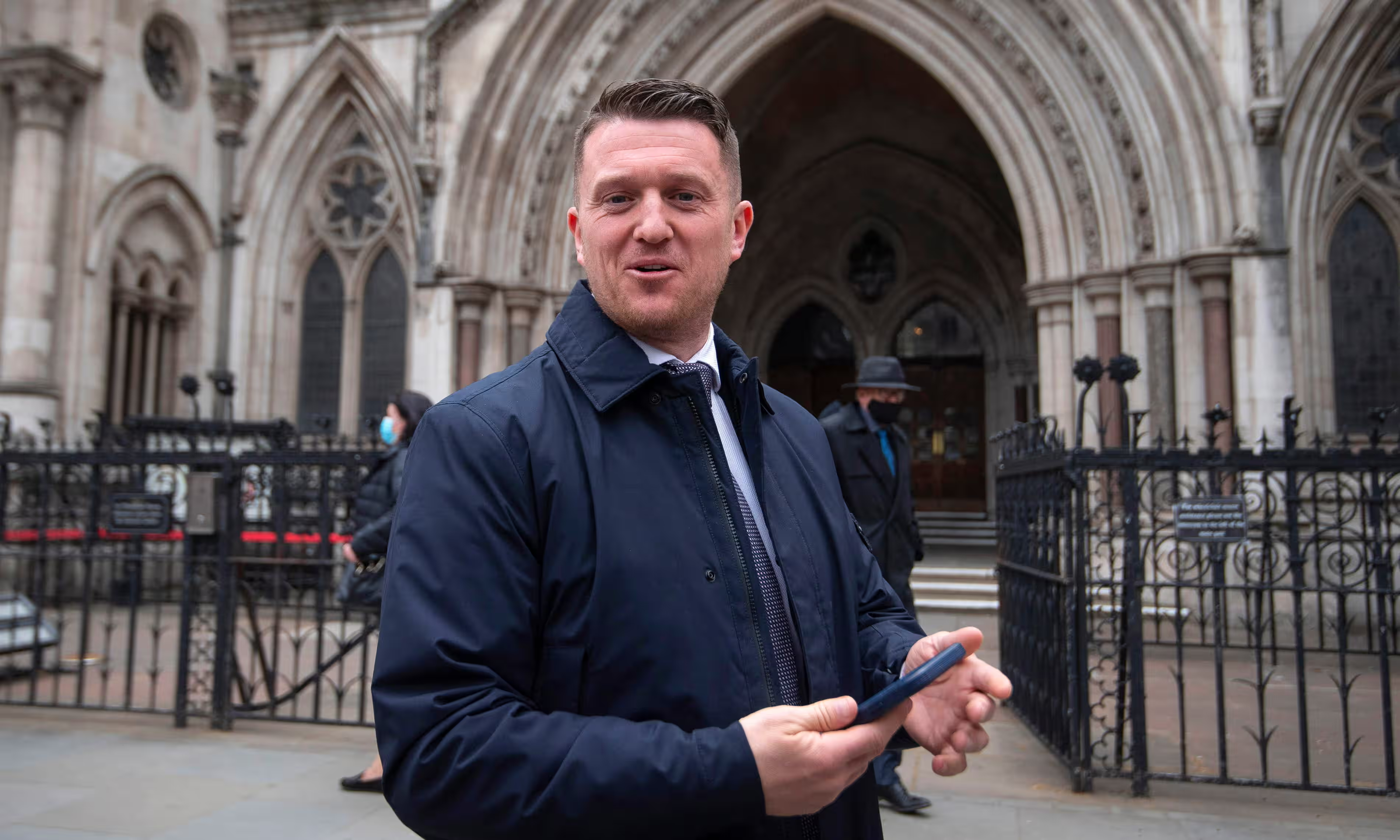
Stephen Yaxley-Lennon, better known as “Tommy Robinson”, will continue to serve an 18-month prison sentence after the Court of Appeal (Civil Division) today upheld a contempt ruling against him. The Panel—led by Dame Susan Carr, the Lady Chief Justice, sitting with Lord Justice Edis and Lord Justice Warby—dismissed all grounds of appeal and re-affirmed the High Court’s findings that Yaxley-Lennon had repeatedly and deliberately breached a court injunction.
The case, Stephen Yaxley-Lennon v HM Solicitor General and another [2025] EWCA Civ 476, centred on ten admitted breaches of an injunction issued following a 2021 libel judgment in favour of Jamal Hijazi, a Syrian refugee and former schoolboy at the centre of a widely publicised bullying incident.
It follows the failure of a related judicial review last month, in which Mr Justice Chamberlain rejected all four grounds as ‘not arguable’.
Background: From Libel to Contempt
In 2021, Mr Justice Nicklin ruled that Yaxley-Lennon’s social media claims portraying Hijazi as a violent aggressor were false and defamatory. Damages of £100,000 were awarded to Hijazi, alongside an injunction barring further repetition of the libels.
Tommy Robinson supporters, led by the author of two his books and litigation friend, Danny Lockwood, claim vehemently that the libel trial was ‘unfair’ and the judge was ‘biased against Tommy throughout’.
Despite the injunction—and, perhaps, motivated by a sense that he had been treated unfairly—Yaxley-Lennon continued to publish prohibited material—including a film titled Silenced (also the title of one of Danny Lockwood’s books, distributed via social media and YouTube, and repeated allegations in multiple interviews.
The contempt proceedings were brought by the Solicitor General in two waves between 2023 and 2024. On 28 October 2024, Mr Justice Johnson found Yaxley-Lennon in contempt on ten counts and imposed an 18-month custodial sentence.
The breaches were not trivial. The revised version of Silenced alone was viewed 44 million times on social media and a further 1 million times on YouTube. The judge concluded the film was a calculated attempt to undermine the libel judgment and the court’s authority.
The Appeal: Arguments Rejected
Yaxley-Lennon’s appeal was filed 105 days late. His new legal team argued that the sentence was excessive, citing deteriorating prison conditions, a recent diagnosis of ADHD, and worsened mental health. They also raised concerns about the difference between civil and criminal detention regimes, including access to early release.
Three of the seven grounds were abandoned at the hearing on 11th April 2025. The remaining four were all rejected.
The Court found that the prison conditions, while restrictive, had been anticipated by the sentencing judge and were not materially harsher than expected. His segregation at HMP Woodhill, the Court noted, was based on risk assessments for his own safety, not arbitrary punishment.
The claim that Yaxley-Lennon’s ADHD diagnosis and complex PTSD merited a reduced sentence was also dismissed. The Court found this new evidence did not differ meaningfully from earlier psychological assessments considered in prior contempt proceedings. “The evidence falls far short of the standard for a successful criminal appeal based on fresh medical evidence,” the judgment stated.
Arguments based on discrepancies in early release regimes between civil and criminal prisoners were deemed irrelevant to sentencing. The Panel concluded that such distinctions, though real, did not render the 18-month term excessive or unjust.
Judicial Rebuke: No Remorse, No Reduction
Lady Carr, delivering the lead judgment, praised Mr Justice Johnson’s original sentencing remarks as “scrupulous and impeccable”. The appeal court agreed that Yaxley-Lennon showed no remorse, no intention to comply with the injunction, and had even maintained prohibited content on his platforms during the committal hearing.
The Court emphasised that each individual breach was serious enough to merit custody, and that in total they would have justified the statutory maximum sentence of two years. The sentence imposed already reflected a downward adjustment for mitigation.
Broader Implications
The ruling sends a strong message about the enforceability of court orders in the digital age. With the revised version of Silenced reaching tens of millions, the Court viewed Yaxley-Lennon’s defiance as especially harmful.
Though some of his supporters frame his actions as free speech, the judiciary sees them as unlawful defamation and contempt. “Freedom of expression does not extend to repeated violations of court orders,” the Lady Chief Justice underscored.
Public reaction has been polarised. On X (formerly Twitter), posts ranged from praise for the rule of law to criticism alleging political persecution. One faction hailed the outcome as a “victory for justice”, whilst another decried it as “an assault on free speech”.
Comment
This judgment reaffirms a principle too often ignored in online discourse: That no individual, however influential, is above the law. Yaxley-Lennon has repeatedly positioned himself as a martyr for free speech, but the courts have consistently found his conduct to be defamatory and contemptuous.
With multiple prior findings of contempt on record (2017, 2019, 2022), and fresh breaches committed even while legal proceedings were ongoing, the 18-month sentence cannot reasonably be viewed as disproportionate. If anything, it reflects the judiciary’s patience finally reaching its limit.
Despite considerable financial backing—including reports linking the funding of this appeal and the recent judicial review application challenging segregation to Elon Musk— Stephen Yaxley-Lennon’s legal team, led by Alisdair Williamson KC, struggled to construct a coherent or credible case. In both this appeal, and the JR, the courts found the actions to be misconceived and almost wholly lacking in merit.
A stark example of that emerges in the judicial review judgment (R (on the application of Stephen Yaxley-Lennon) v Secretary of State for Justice [2025] EWHC 695 (Admin)) where Mr Justice Chamberlain found all four grounds to be ‘not arguable’, a comprehensive dismissal of every element of the challenge.
For all the expense lavished upon both actions, the advocacy did not translate into legal traction. It is a sharp reminder that in the Royal Courts of Justice, money may talk—but it does not persuade.
As of today, unless Yaxley-Lennon purges his contempt, he will serve at least half of that sentence in custody. The rest of us are left to reflect on the cost of defying judicial authority—and the power of the law to hold even the loudest voices to account.
Corrections: Please let me know if there is a mistake in this article. I will endeavour to correct it as soon as possible.
Right of reply: If you are mentioned in this article and disagree with it, please let me have your comments. Provided your response is not defamatory it will be added to the article.
Photo Credits: Victoria Jones/PA
© Neil Wilby 2015-2025. Unauthorised use, or reproduction, of the material contained in this article, without permission from the author, is strictly prohibited. Extracts from, and links to, the article (or blog) may be used, provided that credit is given to Neil Wilby, with appropriate and specific direction to the original content.
 Neil Wilby Media
Leave a comment