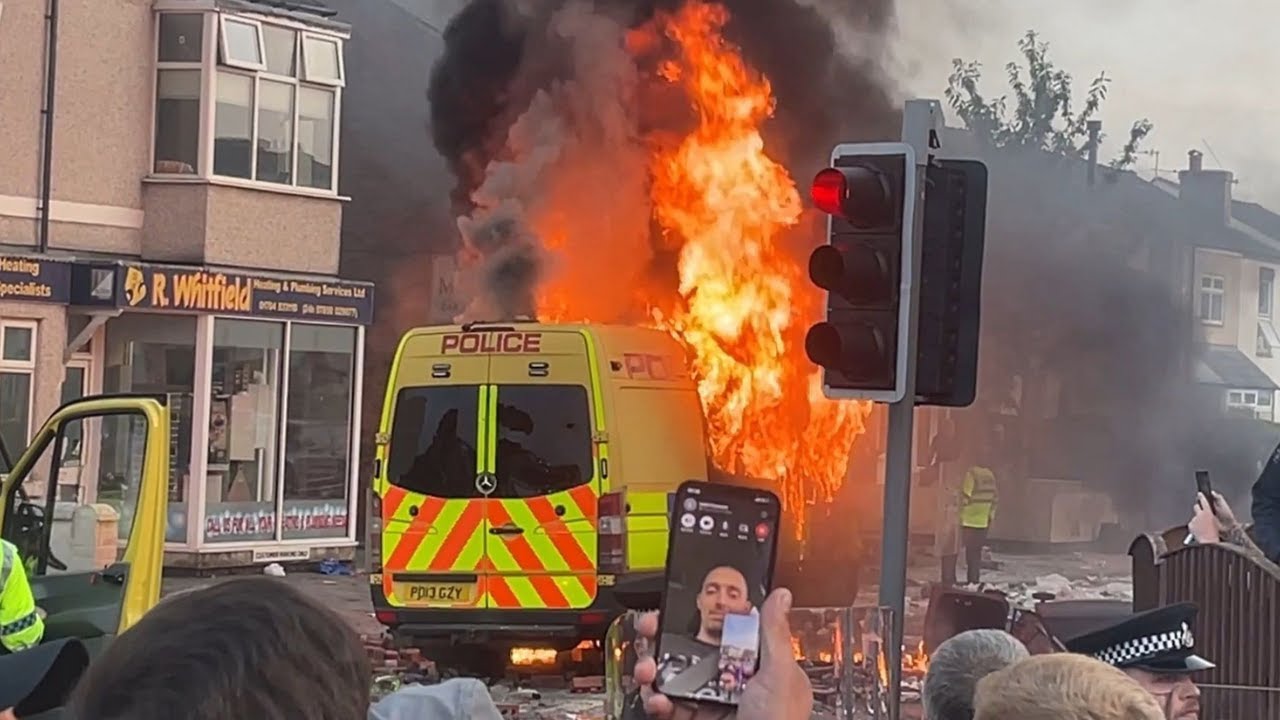
In July 2024, Southport—hitherto, a mostly peaceful seaside town—was rocked by the murders of three young girls at a Taylor Swift-themed dance class. The tragedy sparked riots fuelled by grief, misinformation, and division, with mobs attacking mosques, community centres, and hotels housing asylum seekers.
In a report released earlier this week (14th April, 2025), a Parliamentary Inquiry conducted by the Home Affairs Select Committee has dismissed allegations of ‘two-tier policing’ during the unrest, attributing such claims to online falsehoods. Yet, posts on the social media platform, X (formerly Twitter) reveal a divided public, wrestling with mistrust in policing and the scars of an increasingly polarised society.
The Inquiry’s Conclusions
The Southport Riots unfolded with alarming ferocity. Torched cars, hurled bricks, and assaulted police officers, turning vigils into flashpoints. Critics, from politicians to online commentators, alleged police employed a ‘two-tier’ approach, claiming harsher treatment of right-wing rioters than other protest groups, pointing to perceived racial or political bias.
The Southport Riots unfolded with alarming ferocity. Torched cars, hurled bricks, and assaulted police officers, turning vigils into flashpoints. Critics, from politicians to online commentators, alleged police employed a ‘two-tier’ approach, claiming harsher treatment of right-wing rioters than other protest groups, pointing to perceived racial or political bias.
The Home Affairs Committee’s report has, however, rejected these accusations outright.
Analysing body-cam footage, arrest logs, and officer accounts, the Inquiry found no evidence of bias. Chair Dame Karen Bradley defended the police response as proportionate. “Officers faced petrol bombs, racial slurs, and flying missiles,” she said. “This was about crime, not politics.”
The report details the chaos: 44,438 public order policing shifts, 302 officer injuries, and 1,804 arrests across England. It praised frontline bravery but flagged gaps—outdated riot gear, faltering co-ordination are highlighted—urging reforms to strengthen future responses.
The Spread of Misinformation
Misinformation drove the riots’ intensity. False claims about the suspect, Axel Rudakubana, mis-identified him as an asylum seeker arriving by boat, spreading rapidly on X and Telegram. A fake name, “Ali-Al-Shakati,” appeared in posts viewed millions of times, fuelling anti-Muslim attacks. The inquiry highlighted an “information vacuum” as a key factor. Legal constraints under the Contempt of Court Act 1981 delayed police disclosures to protect Rudakubana’s trial. Merseyside Police’s chief constable, Serena Kennedy, described a 90-minute debate with the Crown Prosecution Service over revealing Rudakubana’s Christian background to counter false narratives, but delays let rumours spiral.
Misinformation drove the riots’ intensity. False claims about the suspect, Axel Rudakubana, mis-identified him as an asylum seeker arriving by boat, spreading rapidly on X and Telegram. A fake name, “Ali-Al-Shakati,” appeared in posts viewed millions of times, fuelling anti-Muslim attacks. The inquiry highlighted an “information vacuum” as a key factor. Legal constraints under the Contempt of Court Act 1981 delayed police disclosures to protect Rudakubana’s trial. Merseyside Police’s chief constable, Serena Kennedy, described a 90-minute debate with the Crown Prosecution Service over revealing Rudakubana’s Christian background to counter false narratives, but delays let rumours spiral.
The Select Committee report calls for modern protocols, proposing real-time fact-checking units and tech platform collaborations to curb misinformation. It noted that posts falsely linking the attack to immigration amassed over 27 million impressions, underscoring the urgency of reform.
A Polarised Public
The inquiry’s findings haven’t quelled debate. X posts from verified users reflect stark divides. Nigel Farage, Reform UK leader, posted on 30 July 2024: “I wonder whether the truth is being withheld from us,” questioning police transparency during the riots and later arguing that “two-tier policing” perceptions persist, citing heavier arrests compared to 2020’s BLM protests. His stance fuels scepticism among followers who see bias in riot policing.
The inquiry’s findings haven’t quelled debate. X posts from verified users reflect stark divides. Nigel Farage, Reform UK leader, posted on 30 July 2024: “I wonder whether the truth is being withheld from us,” questioning police transparency during the riots and later arguing that “two-tier policing” perceptions persist, citing heavier arrests compared to 2020’s BLM protests. His stance fuels scepticism among followers who see bias in riot policing.
In contrast, Lucy Connolly, a councillor’s wife later convicted for inciting violence, posted on X during the riots: “Mass deportation now, set fire to all the hotels,” reflecting community anger but also amplifying divisive rhetoric. Her post, viewed widely before deletion, highlights how local voices can escalate tensions, even if later retracted.
Mrs Connolly is currently serving a 31 months prison sentence which many consider to be very harsh. Public disquiet further fuelled by the present illness of her husband and consequent distress of her young daughter, whilst being denied entitled release on temporary licence (ROTL in prison parlance).
Jonathan Hall KC, the UK’s terrorism legislation reviewer, offered a measured view, posting on X about the riots: “Law stokes the risk of disinformation when police can’t share facts fast.” His call for legal reform aligns with the inquiry’s push for better communication, grounding the debate in policy over emotion.
These perspectives mirror broader mistrust. A 2024 YouGov poll found only 55% of UK adults trust police impartiality, with lower confidence among minorities, shaped by historical issues like the 1999 Macpherson Report’s findings of institutional racism. A Southport imam, speaking at a forum, praised police protection of a mosque but urged dialogue to address past tensions. For many, the Inquiry’s conclusions sidestep deeper questions of fairness.
Implications for Policing
The riots exacted a heavy toll. Beyond 302 injuries—69 requiring hospitalisation—officers faced mental health crises, with rising PTSD cases. The inquiry commended their courage, but exposed flaws: Intelligence failed to predict the scale of the unrest and the speed at which it escalated, and coordination buckled as a result. Court delays, with some riot cases still pending, further undermine public faith.
The riots exacted a heavy toll. Beyond 302 injuries—69 requiring hospitalisation—officers faced mental health crises, with rising PTSD cases. The inquiry commended their courage, but exposed flaws: Intelligence failed to predict the scale of the unrest and the speed at which it escalated, and coordination buckled as a result. Court delays, with some riot cases still pending, further undermine public faith.
The report proposed a national public order strategy, including better training, modern equipment, and officer welfare support. It stressed rebuilding trust, particularly in communities affected by practices like stop-and-search, which disproportionately target Black and Asian individuals. Without action, the inquiry warned, future unrest could widen divides.
A Path Towards Healing
Southport’s riots expose trust’s fragility in a digital age. The inquiry seeks to restore confidence, but X posts show reports alone can’t bridge divides. Misinformation and perceived inequity demand bold steps.
Southport’s riots expose trust’s fragility in a digital age. The inquiry seeks to restore confidence, but X posts show reports alone can’t bridge divides. Misinformation and perceived inequity demand bold steps.
The committee suggested community-led forums, like Bristol’s, where residents and police discuss grievances, easing tensions. It also backed digital literacy campaigns, citing a 2023 Scotland trial that cut misinformation reports by 20%. Transparent communication is vital—police should share partial updates during crises, supported by independent oversight to ensure accountability.
Southport mourns Bebe King, Elsie Dot Stancombe, and Alice da Silva Aguiar, while grappling with fear and distrust. As Jonathan Hall noted, outdated laws hinder truth. Rebuilding faith requires dialogue, reform, and truth—and starts with listening to a wounded community.
Page last updated: Wednesday 16th April, 2025 at 17h15
Corrections: Please let me know if there is a mistake in this article. I will endeavour to correct it as soon as possible.
Right of reply: If you are mentioned in this article and disagree with it, please let me have your comments. Provided your response is not defamatory it will be added to the article.
Photo Credits:
© Neil Wilby 2015-2025. Unauthorised use, or reproduction, of the material contained in this article, without permission from the author, is strictly prohibited. Extracts from, and links to, the article (or blog) may be used, provided that credit is given to Neil Wilby, with appropriate and specific direction to the original content.
 Neil Wilby Media
Leave a comment