This latest Neil Wilby Media exclusive examines the National Police Chiefs’ Council (NPCC) response to a Freedom of Information Act (FOIA) request regarding the numbers of senior police officers and their disciplinary status, submitted by the report’s author, Neil Wilby, an accredited journalist with extensive experience in policing matters.
The request, made on 3rd December, 2024, specifically sought data on officers of chief superintendent rank and above, including those suspended or on restricted duties. The NPCC’s response, dated the same month, claimed it does not centrally hold this information, it being managed, instead, by individual forces.
This report focuses on the scepticism surrounding this claim, highlighting the tendency of policing bodies, including the NPCC, to prioritise protecting the police service’s reputation over openness and transparency, and its implications for public trust and accountability.
Additionally, it incorporates the journalist’s personal experience of having all their policing FOIA requests referred to the NPCC’s Central Referral Unit (CRU) from around 2013 until at least 2020, which underscores the centralised role of the CRU in managing FOI responses.
The NPCC stated that it does not centrally collate the requested information on the numbers of senior police officers or their disciplinary statuses. The police chiefs claim that individual police forces manage their own data, with disciplinary information handled by each force’s Human Resources or Professional Standards departments.
For access to such data, the NPCC directed the applicant to contact individual police forces via the Police UK website (Police UK).
This decentralised approach is consistent with the UK’s federated policing system, where the 43 territorial police forces in England and Wales, along with forces in Scotland and Northern Ireland, retain autonomy over certain operational aspects.
However, given the NPCC’s role in coordinating national policing efforts, setting standards, and responding to strategic threats, as outlined on its website (The National Police Chiefs Council), it seems extraordinary that it would not have access to such critical data.
Neil Wilby, expresses genuinely held doubts, stating, “Given my many years of experience holding police forces, and their chief constables, to account, I seriously doubt this claim, especially considering the importance of senior officer accountability for public trust. It is inherently implausible”.
The NPCC’s Central Referral Unit (CRU), part of the National Police Freedom of Information and Data Protection Unit (NPFDU), has been advising police forces on how to respond to FOI requests for many years.
In fact, from around 2013 until at least 2020, almost all FOIA requests made by the journalist to various police forces were systematically referred to the CRU. This practice suggests a high degree of centralised coordination in handling sensitive information requests, which casts doubt on the NPCC’s assertion that it does not centrally hold data on the disciplinary status of very senior police officers.
If the CRU is advising forces on FOI responses, it implies that there is a mechanism for centralised oversight of information disclosure, potentially including data on senior officers.
The CRU’s role includes providing advice and support on FOIA and Data Protection Act (DPA) issues to law enforcement agencies, coordinating the strategic development of the Act throughout the police service, and maintaining relationships with partner agencies and requestors at a national level.
It also produces and delivers FOI/DPA training, workshops, and professional development events, manages intelligence related to the misuse of legislation, and ensures that national policing leads can contribute to information disclosure decisions. The CRU’s establishment predates 2013, as evidenced by its operational role in advising forces during that period, though exact establishment details are not readily available.
This historical context is crucial, as it aligns with the journalist’s experience of having all requests referred to the CRU, suggesting a long-standing practice of centralized management of FOIA responses. For instance, a 2014 article from the NPCC (read in full here) mentions the CRU advising on FOIA requests related to the Regulation of Investigatory Powers Act, 2000 (RIPA), indicating its active role by that time.
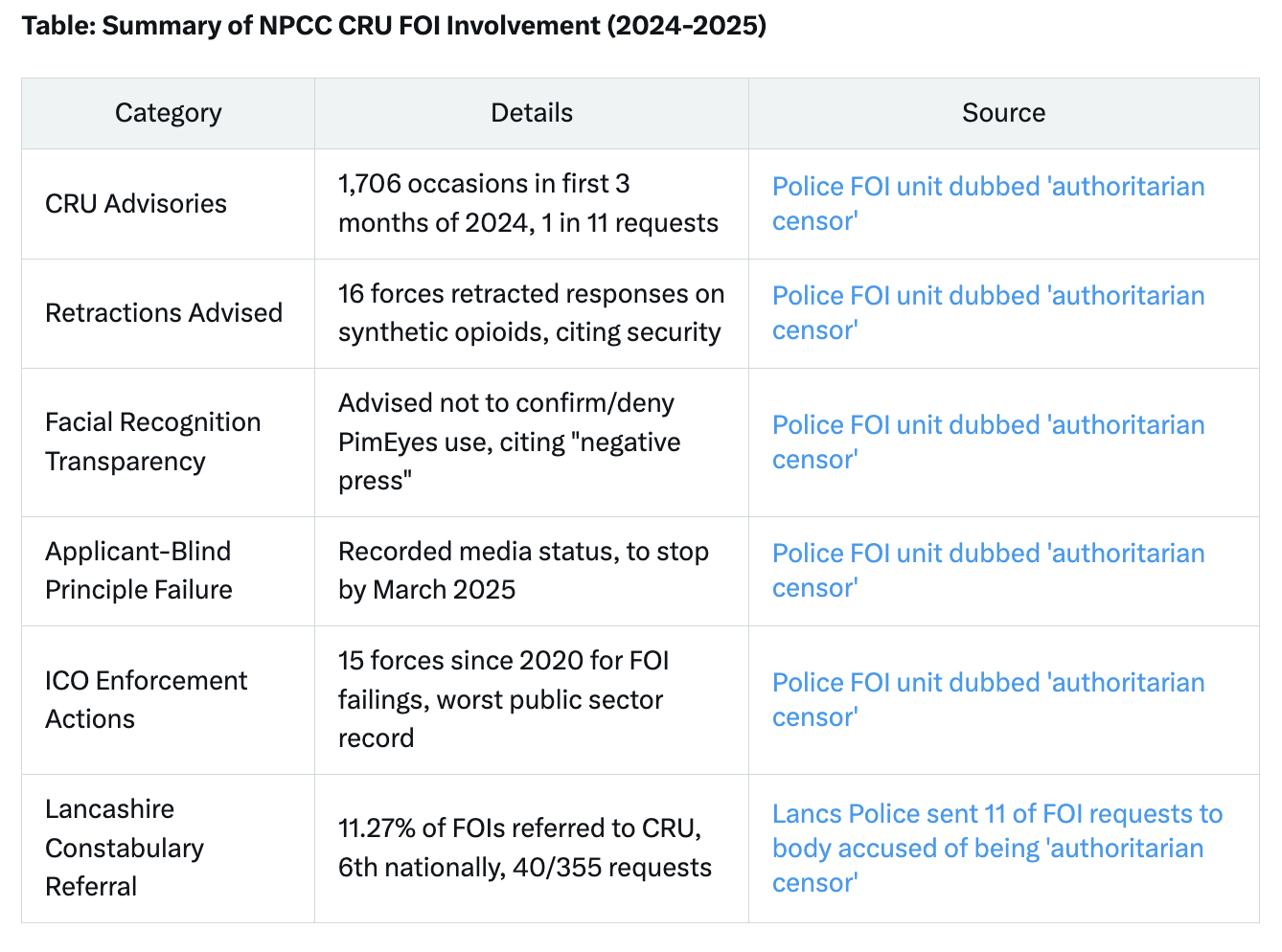
Recent investigations into the NPCC’s handling of FOI requests have uncovered a pattern of practices that suggest a prioritisation of reputation over transparency. A BBC article published on March 6, 2025, titled “Police FOI unit dubbed ‘authoritarian censor’” (read in full here), detailed the activities of the NPCC’s Central Referral Unit (CRU), responsible for advising police forces on FOIA responses.
The investigation found that the CRU advised local forces on 1,706 occasions in the first three months of 2024, equivalent to one in every eleven requests submitted to forces in that time. This significant involvement raises questions about the NPCC’s influence over transparency.
The counter-argument from the NPCC, and its CRU, is that it operates within legal frameworks and that internal discussions about ‘negative press’ are for research, not to sway disclosure decisions.
Specific instances include the CRU advising sixteen forces to retract earlier responses on synthetic opioids, citing national security, and instructing forces not to confirm or deny whether their officers had used the facial recognition search engine PimEyes, citing concerns about “negative press.” PimEyes has been banned by Scotland Yard, as noted in related reports (read more here).
Jake Hurfurt, Head of Research and Investigations at Big Brother Watch, criticised this, stating, “Pressurising police forces to retract data was ‘the practice of an authoritarian censor not an accountable public body.’
He added: ‘It is alarming that the NPCC is going beyond giving advice to individual forces and instead seemingly orchestrating how every force responds to sensitive transparency requests,’”
Another article, published by the Lancashire Telegraph on 17th March, 2025, titled “Lancs Police sent 11 of FOI requests to body accused of being ‘authoritarian censor’” (read in full here), revealed that Lancashire Constabulary referred 11.27% of its FOIA requests to the CRU, placing it sixth nationally, with 40 out of 355 requests.
This article reiterated the criticism from Big Brother Watch and noted that over one-third of UK forces redacted FOIAs on banned surveillance software and super-strength drugs, while forces retracted responses on PimEyes usage. It also highlighted that the CRU recorded whether requesters were members of the media, violating the applicant-blind principle, a practice set to stop by March 2025.
The evidence leans toward policing bodies, including the NPCC, tending to put the protection of the police service’s reputation ahead of openness and transparency. This is further supported by the Information Commissioner’s Office (ICO) taking enforcement action against 15 police forces since 2020 for FOI failings, the worst public sector record, as detailed in the BBC article linked above.
Specific cases include Surrey and South Yorkshire Police being issued enforcement notices in 2024 for missing 20-day FOI deadlines, indicating systemic compliance issues.
The CRU’s practices also failed the applicant-blind principle, recording media status to potentially influence responses, which undermines the spirit of the the Act, as noted in the ICO’s Guidance on FOIA.
This violation, set to be addressed by March 2025, highlights a lack of adherence to transparency standards. Expert opinion, such as from Claire Miller, mentioned in the Lancashire Telegraph, emphasised that the NPCC is not operating within the spirit of the Act, needing further investigation.
The lack of centralised data on senior police officers, as claimed by the NPCC, has significant implications for transparency and accountability. Public trust in policing relies on access to information about officer conduct, particularly at senior levels, where decisions can have broad impacts.
The claimed decentralised system means that researchers, journalists, and oversight bodies must request data from each force, potentially leading to inconsistencies and delays, as seen in the NPCC’s direction to use the Police UK website for individual force contacts (Police UK).
This fragmentation may hinder national-level analyses of disciplinary trends, such as the number of senior officers suspended or on restricted duties, crucial for understanding accountability mechanisms.
The NPCC’s role in coordinating responses to national threats, as outlined on its website, very largely makes the case for centralised collection of data of this class, but current practices prioritise local autonomy, potentially as a shield against scrutiny.
An unexpected detail is the CRU’s influence extending to orchestrating responses, not just advising, which could explain the NPCC’s claim of not holding data as a way to deflect scrutiny. This is particularly concerning given the NPCC’s own statements on transparency, such as Commander Matt Twist’s blog on use of force data being a “great step forward for transparency,” per the NPCC website (read in full here), contrasting with recent CRU practices.
Conclusion
The NPCC’s specific response to the Neil Wilby FOIA request, claiming not to hold centralised data on senior police officers, is met with scepticism, given its national coordinating role and recent CRU practices. Research suggests a pattern of policing bodies, including the NPCC, prioritising reputation over transparency, as evidenced by CRU advising forces to withhold or retract information, violating FOI principles. This journalist’s lengthy experience of having many of his requests referred to the CRU over a number of years, further highlights the centralised role of the unit in managing information disclosure, sharply contradicting the NPCC’s claim of decentralisation. This has serious implications for public trust and accountability, with the ICO’s actions against forces underscoring compliance issues.
Neil Wilby concludes:“The NPCC’s claim, of not holding centralised data, raises transparency concerns, especially given the CRU’s extensive FOIA involvement and historical referrals, suggesting an urgent need for greater openness in policing.
“With regard to my specific FOIA request, germane to this article, an Internal Review request has been filed with the NPCC. It can be read in full here.”
______________________________________________________________________________
Page last updated: Wednesday 19th March, 2025 at 13h55
Corrections: Please let me know if there is a mistake in this article. I will endeavour to correct it as soon as possible.
Right of reply: If you are mentioned in this article and disagree with it, please let me have your comments. Provided your response is not defamatory it will be added to the article.
Photo Credits: NWM
© Neil Wilby 2015-2025. Unauthorised use, or reproduction, of the material contained in this article, without permission from the author, is strictly prohibited. Extracts from, and links to, the article (or blog) may be used, provided that credit is given to Neil Wilby, with appropriate and specific direction to the original content.

 Neil Wilby Media
Leave a comment