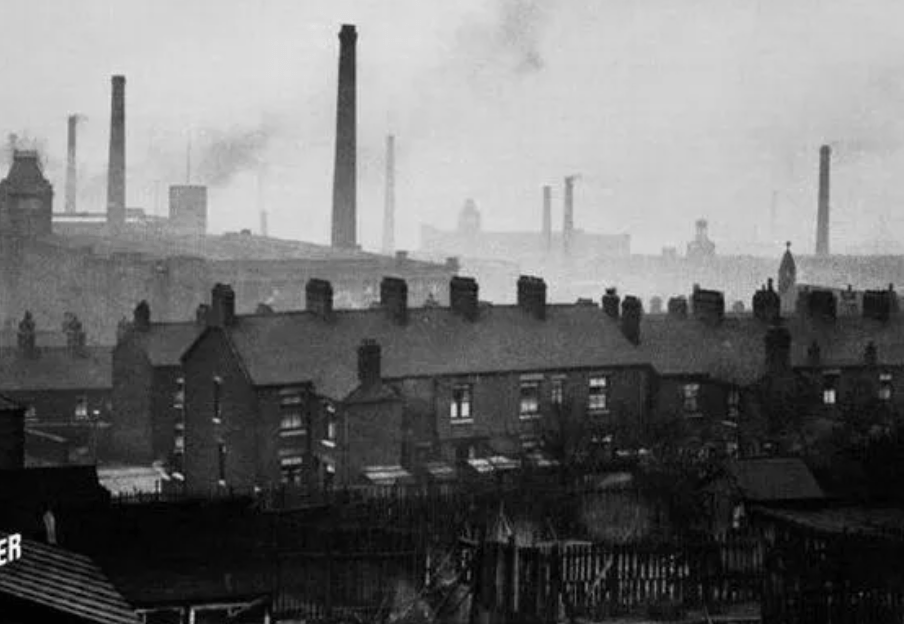
Another tumultuous month in a famous old East Lancashire mill town, once a major centre for cotton spinning and textile production hub that brought great wealth to the mill and factory owners and jobs for those from the rural backwaters, has generated another raft of articles here on this Neil Wilby Media website featuring its troubled, and now infamous, political scene (read here).
History records that Oldham’s cotton industry thrived due to its proximity to Manchester, which was considered to be the centre of the World’s cotton trade during that time. The abundant availability of raw cotton, advancements in spinning and weaving technology, and the development of transportation infrastructure contributed to the town’s success in cotton manufacturing.
The cotton industry played a significant role in shaping Oldham’s economy and society. It brought employment opportunities, attracted workers from rural areas, and transformed it into a bustling industrial town. However, the decline of the cotton industry in the mid-20th century led to significant changes in Oldham’s economic landscape. Many mills closed down, and the town shifted towards other industries and sectors.
Nonetheless, the legacy of the town’s cotton industry can still be seen in its architecture, industrial heritage, and cultural identity.
Oldham also has a notable political history with several key events and movements that have shaped its political landscape. Here are some highlights:
Suffrage Movement: Oldham played a significant role in the suffrage movement in the late 19th and early 20th centuries. The town was a centre of women’s suffrage activism, and notable suffragettes such as Annie Kenney, a working-class woman from Oldham, were involved in the movement.
Trade Unionism: Oldham has a strong tradition of trade unionism, particularly in the textile industry. Workers in Oldham played an active role in organising and advocating for workers’ rights, better wages, and improved working conditions.
Labour Movement: Oldham has historically been a stronghold for the Labour Party. The town has seen a strong presence of Labour politicians and a significant number of Labour MPs representing the constituency over the years. The local Council has been under the continuous control of Labour since 2011, although presently hanging on by a thread.
Racial Tensions: Oldham has also faced challenges related to racial tensions and social integration. In the early 2000s, the town experienced wide-scale riots and unrest, reflecting broader issues of racial inequality and community divisions. There was a smaller scale riot in the Limeside area of the town in 2019.
Far-Right Politics: Oldham has been a focal point for far-right political groups, particularly in the 1990s and early 2000s. The British National Party (BNP) gained significant support in Oldham during this period, leading to heightened racial tensions and conflicts. Later in the new century, the Borough was targeted by the English Defence League (EDL) and the United Kingdom Independent Party (UKIP).
Overall, Oldham’s political history reflects a mix of progressive movements, working-class activism, and challenges related to racial and social tensions. The town continues to be an important political and social hub in the Greater Manchester Region.
Both the EDL and UKIP have had an impact on Oldham politics over the last two decades and their activists and supporters continue to do so under the banner of ‘The Rabble’ or ‘Raja’s Rabble’ for reasons that unfold further into this piece.
The EDL was a far-right, anti-Islam organisation that emerged in 2009 under the leadership of Tommy Robinson (real name: Stephen Yaxley-Lennon). It organised protests and demonstrations in various parts of the UK, including Oldham. These events often sparked tensions and debates around issues such as immigration, multiculturalism, and Islamophobia. The EDL’s presence and activities in Oldham, as in other areas, have been met with opposition from local communities and counter-protesters who advocate for inclusivity, diversity, and social cohesion.
UKIP gained prominence in the early 2010s, primarily advocating for the UK’s withdrawal from the European Union. While UKIP’s main focus was on national politics and Brexit, its policies and messaging on issues such as immigration and cultural identity resonated with some voters in Oldham and other parts of the country. UKIP candidates contested elections in Oldham, including local council elections and parliamentary by-elections. A former Labour, Green party and Liberal Democrat activist, Warren Bates, was elected as a UKIP councillor in 2014.
It is important to note that the influence and impact of these political movements can vary over time, and their presence in Oldham’s politics has evolved. Cllr Bates fell out with UKIP, or vice-versa, during his term of office, which ended in 2018. He has since stood, unsuccessfully, as a candidate for the Brexit Party and as an independent.
Local politics in any area can be shaped by a range of factors, including economic conditions, social dynamics, and the engagement of various political groups and parties. Or, in the specific case of Oldham Metropolitan Borough through the activities on one notorious conspiracy theorist, who hasn’t lived in the locality since 2004, and a small group of cranks, axe-grinders and political malcontents, numbering at their peak at around 200.
The Rabble, as they self-style, is omnipresent on social media and the wider internet, many of them on State benefits in one form or another, which gives a distorted impression of the size of the group and its influence. It is also a haven for the remnants of the BNP, EDL and UKIP in Oldham, peppered with an uncomfortable number of racists, unaffiliated far-right activists and assorted criminals. Including the Borough’s most notorious burglar and scammer, one convicted of large-scale drug running and another of people-trafficking.
One prominent Rabbler was convicted, along with others, of starting the Oldham riots in 2001. Another was spotted in Tommy Robinson‘s vehicle at the 2019 riot. Yet more are retired or ex-police officers, some of them prominent as whistleblowers, whom served in a force identified as ‘institutionally racist’. An uncomfortable proportion of their output on social media gives some clue as to why that might be.
At the head of The Rabble cult stands Raja Miah, unemployed since 2017 but still living in plush splendour in the upmarket commuter village of Mossley, Tameside and driving a top of the range BMW car. He left Oldham as soon as he could afford to do so in 2004, but still claims it as ‘my town’ or ‘our town’ when embracing his supporters whom, for obvious reasons are also well recognised as Raja’s Rabble. It is estimated they have funded Miah to the tune of £40,000 over the past 4 years. Ex-UKIP Cllr, Warren Bates, mentioned earlier is widely touted as a close confidant of Miah and a Rabble ‘legend’.
The glue that sticks all this together is the disgraced, frequently-banned suite of ‘Recusant Nine’ social media channels and its perennial far-right grooming gangs trope. To which local colour is added by Miah whom repeatedly and loudly insists that ‘Asian block votes at local and general elections are secured by the Labour Party in return for the ‘cover-up’ of gang-rape of 1,000s of white working class girls by Pakistani men’. Accompanied by lurid tales of Cartels, mobsters, gangsters, goons, armed robbers, car-jacking and murder plots.
The ‘cover-up’, according to Rabble folklore, is not confined to Labour politicians in Oldham. Their conspiracy theory draws in an entire regional police force, its safeguarding partners, senior paid council officers, and the local and regional press.
But ask Raja Miah, Warren Bates, or any other member of The Rabble, and especially the ex-cops, to show the evidence of this grooming for votes conspiracy, where, when, how and by whom, and they run a mile.
A ‘dossier’ that Miah claims has existed for over three years still remains locked away. He refused to co-operate, and have that ‘dossier’ tested, with an independent review team that found no evidence of such a ‘cover-up’ and in which the Conservative government has repeatedly expressed full confidence in the investigators and the outcome (read more here).
Notwithstanding, Miah and his very small group of supporters claim, with partial justification, to have ousted three successive Oldham Council Leaders and reduced the number of Labour councillors from 45 to 32 during their reign of attrition. That hyperbole does, however, tend to discount the poor organisation, strategy, tactics – and stultifying fear – of both a significant section of the local Labour Group and senior paid council officers, whose response to a grotesque, long-running smear campaign, with some notable exceptions on occasions, is: Ignore them and hopefully they will all go away.
It is a threadbare scheme that will continue to fail – and not just the Council’s diminishing Labour administration, surrounded by weak, supine senior executives, but the public they are either elected or paid to serve. Oldham is the loser and the grim, shameful reputation with which it is now burdened in the media, locally, regionally and nationally impacts on every man, woman and child living in the town or wider Borough.
There has to be a change of plan by those running Oldham Council and a much sharper focus upon tackling the darker corners of Oldham’s (and Greater Manchester’s) internet and confronting head-on the routine hate, division and libellous smears.
In 2014, Parliament gave councils and other public authorities, including the police, very specific powers to do just that. It is a travesty that injunction court proceedings under the Anti-Social Behaviour, Policing and Crime Act (read in full here) were not filed and served on Raja Miah and key members of his support group.
For Cllr Arooj Shah, re-elected as Leader of Oldham Council for a second term in May, 2023, and one very regularly targeted by Miah and The Rabble, this is the right time to review the Labour strategy, leverage the collective audience her fellow elected Members, and other Party activists or supporters, enjoy and drown the Recusant Nine negativity both in the council chamber and on social media.
In the case of the departing Chief Executive, Harry Catherall, and Borough Solicitor, Paul Entwistle, also both regular Recusant Nine targets, their parting gift to Oldham Council could be retaining specialist leading counsel to guide injunction proceedings against Raja Miah and others to a successful conclusion.
UPDATE: During week commencing 11th September, 2023, Raja Miah was given notice by Oldham Council’s Legal Services Department that a leading firm of solicitors had been retained to bring injunction proceedings against him (read full story here).
Follow Neil Wilby on Twitter (here) and Neil Wilby Media on Facebook (here) for signposts to any updates.
Page last updated: Saturday 16th September, 2023 at 11h25
Thank you for reading and a polite request: If you feel this article is of value and in the public interest, and wish to make a contribution to the running costs of this website, it would be very much appreciated. Donations can made securely (and anonymously if required), via Buy Me A Coffee at this link or via PayPal at this link.
Corrections: Please let me know if there is a mistake in this article. I will endeavour to correct it as soon as possible.
Picture credit: Oldham Council
Right of reply: If you are mentioned in this article and disagree with it, please let me have your comments. Provided your response is not defamatory it will be added to the article.
© Neil Wilby 2015-2023. Unauthorised use, or reproduction, of the material contained in this article, without permission from the author, is strictly prohibited. Extracts from, and links to, the article (or blog) may be used, provided that credit is given to Neil Wilby Media, with appropriate and specific direction to the original content.

 Neil Wilby Media
Leave a comment