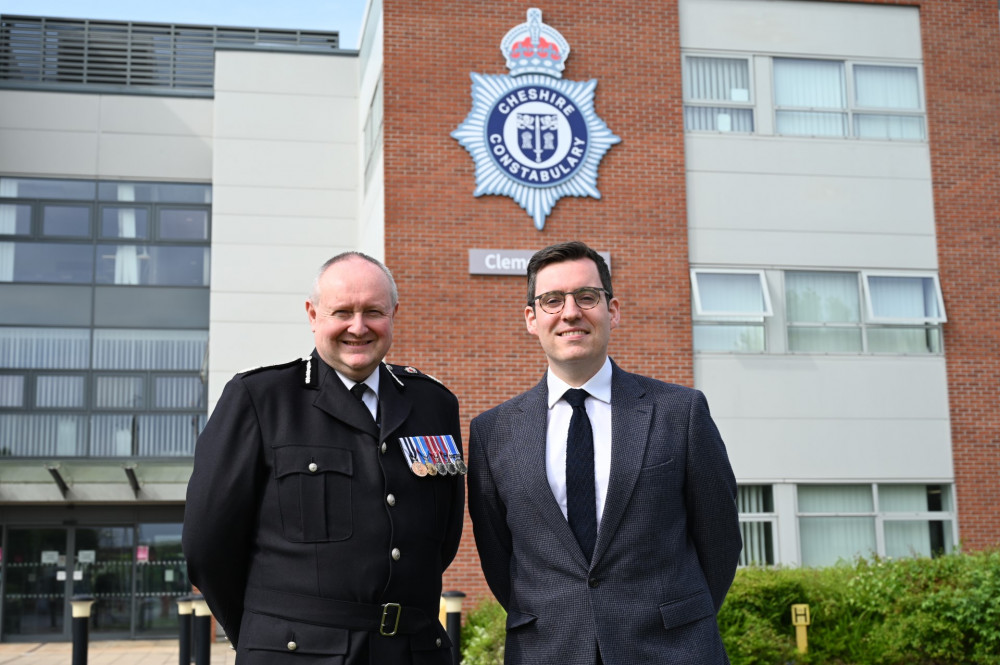
In the wake of an increasingly public dispute between Mark Roberts (pictured above left) and David Davis MP over the conduct of Operation Hummingbird, the long-running police investigation that led to te conviction of neonatal nurse, Lucy Letby, attention has turned to whether the chief constable’s intervention could, in principle, engage the police disciplinary framework.
In practice, any such complaint would not be submitted directly to the Independent Office for Police Conduct (IOPC). Complaints concerning a chief constable are first considered by the relevant Police and Crime Commissioner, who is responsible for holding the force to account.
However, where allegations are of sufficient seriousness — as may be the case here — the Commissioner, in this case Cheshire’s Dan Price, is required to refer the matter to the IOPC, which then determines the mode of investigation.
Rather than advance a concluded view, Neil Wilby Media has reconstructed how a formal complaint to the PCC/IOPC might be framed, drawing on the Standards of Professional Behaviour set out in Schedule 2 of the Police (Complaints and Misconduct) Regulations 2020, and the competing correspondence already exchanged between the MP and the police chief, both now widely available in the public domain.
What follows is not a formal complaint, but a worked example — intended to assist readers in understanding the legal and professional thresholds that would apply were such a complaint to be made.
Complainant:
A Member of Parliament or other directly affected party
Against:
Mark Roberts
Force:
Cheshire Constabulary
1. Nature of Complaint
This complaint concerns the conduct of the chief constable of Cheshire Constabulary in relation to statements made in his letter dated 8th April 2026 to Sir David Davis MP, following a Parliamentary adjournment debate on 26th March 2026 concerning perceived irregularities in Operation Hummingbird.
A complainant might allege that the chief constable:
- Made statements which were false, misleading, or presented with reckless disregard for their accuracy, contrary to the Standards of Professional Behaviour relating to Honesty and Integrity; and
- Acted in a manner liable to undermine public confidence in policing, contrary to the standard relating to Discreditable Conduct.
These matters arise in the context of an ongoing review by the Criminal Cases Review Commission and wider public concern regarding the integrity of the underlying investigation.
2. Relevant Standards of Professional Behaviour
The complaint would rely primarily upon:
- Honesty and Integrity
Officers must act with honesty and integrity and must not knowingly or recklessly make false, misleading, or inaccurate statements. - Discreditable Conduct
Officers must not act in a manner which discredits the police service or undermines public confidence in it.
Reference is made to Schedule 2 of the Police (Conduct) Regulations 2020.
3. Factual Background
3.1 The Parliamentary Context
On 26th March 2026, Sir David Davis MP delivered an adjournment debate in the House of Commons raising concerns about the conduct of Operation Hummingbird.
The debate drew upon a substantial body of material, including publicly available documents, expert commentary, and analysis of trial evidence.
3.2 The Chief Constable’s Letter (8th April 2026)
By letter dated 8th April 2026, the chief constable wrote to Sir David Davis asserting, inter alia, that:
- The MP’s statements were “materially inaccurate and misleading to Parliament”;
- The investigation was conducted with an open mind, with no premature focus on any suspect;
- The investigation did not rely upon a single medical expert;
- The Constabulary did not seek or receive statistical analysis, and no statistician was engaged.
The Chief Constable further invited the MP to correct the Parliamentary record by raising a Point of Order.
3.3 The MP’s Response (13th April 2026)
In his reply of 13th April 2026, Sir David Davis set out detailed rebuttals supported by documentary material, including:
- Evidence suggesting that focus on a specific suspect arose at a very early stage of the investigation;
- Evidence that expert advice was not as broad or independent as asserted;
- Evidence that a statistician was engaged, including requests for assistance, a consultancy agreement, and invoicing for work undertaken, before that line of inquiry was discontinued.
4. Alleged Breach: Honesty and Integrity
4.1 Misleading Statements of Fact
A complainant might contend that the chief constable’s letter contains categorical factual assertions which are open to challenge, including:
- That no statistician was instructed or report obtained;
- That the investigation did not focus on a suspect until June 2018;
- That expert evidence was gathered through a fully robust and multi-disciplinary process.
These assertions are now the subject of direct dispute, supported by documentary material cited in the MP’s response.
4.2 The Statistical Evidence Issue
Particular concern may arise in relation to the statement that no statistical expertise was sought or obtained.
A complainant might point to evidence suggesting that:
- Statistical assistance was actively sought by investigating officers;
- A consultancy arrangement was entered into;
- Work was undertaken and invoiced;
- The line of inquiry was later discontinued following prosecutorial direction.
Even if no statistical evidence was ultimately deployed in court, the distinction between “not relied upon” and “not sought or obtained” may be material.
4.3 Knowledge or Recklessness
Given:
- The scale and duration of the investigation;
- The seniority of the officer concerned;
- The specificity of the assertions made;
a complainant might submit that the statements were made either:
- With knowledge of their inaccuracy; or
- With reckless disregard as to whether they were accurate.
4.4 Overstatement and Selective Presentation
The letter also employs a number of absolute or unqualified formulations, including assertions that the investigation was exhaustive and that alternative interpretations lack credibility.
In a context involving:
- Ongoing review by the Criminal Cases Review Commission;
- Evidential complexity;
- Continuing professional and public debate;
a complainant might argue that such language risks being misleading by omission, in failing to acknowledge legitimate areas of dispute.
5. Alleged Breach: Discreditable Conduct
5.1 Public Dispute with a Member of Parliament
The chief constable’s decision to:
- Assert that a Member of Parliament had misled Parliament; and
- Invite a formal correction of the Parliamentary record
may be said to constitute an unusually direct intervention in Parliamentary discourse by a serving Chief Constable.
5.2 Impact on Public Confidence
A complainant might argue that this conduct is capable of undermining public confidence by creating the impression that:
- The police service is adopting a defensive posture in response to scrutiny;
- Senior officers are making assertive public claims which are contested by documentary material;
- There is resistance to external examination of a high-profile investigation.
5.3 Effect on Legitimate Scrutiny
It may further be contended that such interventions risk discouraging legitimate scrutiny, including that undertaken by Parliament, in circumstances where:
- Scrutiny has historically played a significant role in exposing miscarriages of justice; and
- The present case remains subject to ongoing review.
6. Harm and Public Interest
The matters raised engage issues of substantial public importance, including:
- Confidence in the integrity of major criminal investigations;
- The accountability of senior police officers;
- The relationship between policing and Parliamentary oversight.
A complainant might submit that maintaining public confidence requires that statements made by senior officers are accurate, balanced, and appropriately qualified, particularly in contested and evolving evidential contexts.
7. Outcome Sought
A complainant might invite the IOPC to:
- Determine that the complaint is suitable for independent investigation, having regard to the seniority of the officer concerned and the nature of the allegations;
- Investigate whether there has been a breach of the Standards of Professional Behaviour, in particular:
- Honesty and Integrity;
- Discreditable Conduct;
- Determine whether the conduct amounts to misconduct or gross misconduct;
- Provide a clear and reasoned outcome in the public interest.
8. Supporting Material
- Letter from Chief Constable Mark Roberts to Sir David Davis MP (8th April 2026)
- Letter from Sir David Davis MP to Chief Constable Mark Roberts (13th April 2026)
9. Governance Structure in Cheshire
The formal complaints framework envisages that scrutiny of a chief constable is exercised independently through the Police and Crime Commissioner. In practice, however, governance arrangements within policing are often more closely integrated.
In Cheshire, the chief legal officer, David Bryan, holds senior responsibilities within both the Constabulary and the wider governance structure supporting the Commissioner. Such arrangements are not unusual in modern policing, but they do give rise to a legitimate question as to how operational independence in scrutiny is maintained in practice.
This is not to suggest any impropriety, but rather to highlight the structural reality within which decisions about referral, investigation, and oversight are taken.
10. Closing Note
Whether any such complaint is ultimately made—or upheld—is a matter for others. Neil Wilby has no standing to make such a complaint.
The purpose of this exercise is simply to illustrate how the Professional Standards governing all police officers might be engaged when public statements, made at the highest level, become the subject of sustained and evidence-based challenge.
________________________________________________________________________________________________
Neil Wilby is a journalist, court reporter and transparency campaigner who has reported on police misconduct, regulatory failures, and criminal and civil justice since 2009. He is the founder and editor of Neil Wilby Media, launched in 2015.
Page last updated: Wednesday 15th April 2026 at 14h35
Corrections: Please let me know if there is a mistake in this article. I will endeavour to correct it as soon as possible.
Right of reply: If you are mentioned in this article and disagree with it, please let me have your comments. Provided your response is not defamatory, it will be added to the article.
Image credits: NWM
Contact: Email us via this weblink
© Neil Wilby 2015–2026. Unauthorised use, or reproduction, of the material contained in this article, without permission from the author, is strictly prohibited. Extracts from, and links to the article may be used, provided that credit is given to Neil Wilby, with appropriate and specific direction to the original content.


Leave a Reply