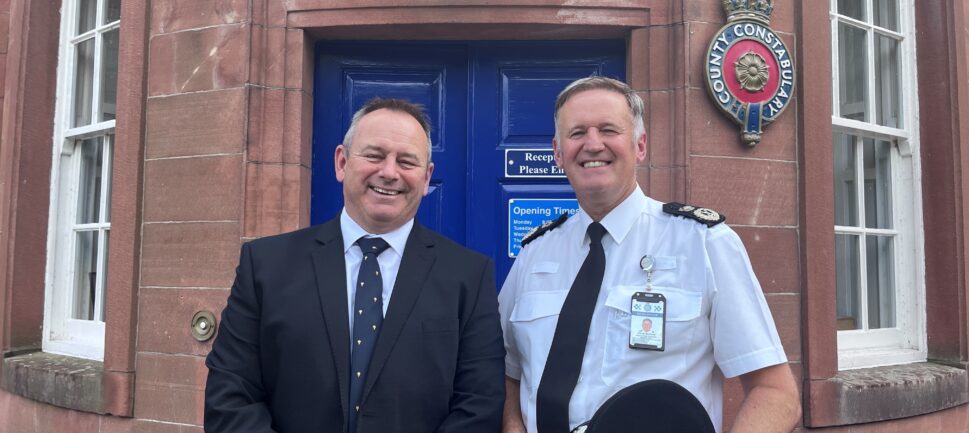
The appointment of a chief constable is one of the most significant decisions in modern policing, placing operational control of a force — and considerable public trust — in the hands of a single officer.
It is a process that depends not only on professional competence and leadership experience, but also on transparency and completeness in how a candidate’s career is presented to those responsible for scrutinising their appointment.
In Cumbria, the recent publication of the official biography of newly appointed Darren Martland, submitted as part of the Police and Crime Commissioner’s appointment process, provides a case study in how those narratives are constructed and, potentially, what they omit.
The biography, published as part of the confirmation process overseen by the Cumbria Police and Crime Commissioner, sets out a conventional account of a senior policing career.
It highlights:
- Extensive police service across Merseyside, Cheshire and Cumbria
- Progression through senior leadership roles
- Broad experience in operational command
- A prominent role in leading policing responses during the COVID-19 pandemic
In tone and structure, it is entirely consistent with similar documents produced for chief constable appointments across England and Wales. It is concise, perhaps unusually so, accessible, and focused on leadership credentials and organisational achievements.
What it does not attempt to do is provide an exhaustive account of every operational role undertaken. That, of itself, is unremarkable.
The question, however, is whether material aspects of the candidate’s professional history, particularly those now subject to wide media coverage, substantial public interest and intense scrutiny, ought, reasonably, to have been included.
One such area concerns Operation Hummingbird, the long-running and only recently concluded investigation, conducted by Cheshire Constabulary into events at the Countess of Chester Hospital, that led to murder and attempted murder convictions against a neonatal nurse, Lucy Letby. The force say that 70 detectives were deployed on the case and, up to September 2023, it had cost the taxpayer £9.7 million.
The investigation’s prominence was further reflected in national recognition through the National Police Chiefs’ Council awards in 2024, when Detective Superintendent Paul Hughes, appointed to lead Operation Hummingbird during its early Gold Command phase under Darren Martland in May 2017, received Senior Investigating Officer of the Year, whilst Operation Hummingbird was also selected in the Investigation Team of the Year category. That recognition arguably adds further weight to the question of whether involvement in the investigation was material information for inclusion in a chief constable appointment biography.
The investigation has, in recent months, become the subject of sustained media, public, professional, and Parliamentary scrutiny, including two adjournment debates in the House of Commons (January 2025 and March 2026) and ongoing assessment by the Criminal Cases Review Commission.
The official Darren Martland biography, some might say surprisingly, makes no reference at all to Operation Hummingbird, despite his force’s very substantial, and almost unprecedented, commitment both in terms of officer deployment and financing.
Material disclosed to the Thirlwall Inquiry places him at the centre of the earliest strategic phase of Operation Hummingbird: A document dated 5th May 2017, recording a senior meeting at Cheshire Constabulary headquarters, identifies Martland, then an assistant chief constable, as Gold Commander for the investigation.
The same document sets out the initial strategic framework for police involvement, including consideration of whether the emerging concerns at the hospital met the threshold for a criminal investigation.
Further Thirlwall material records his participation in another meeting on 12th May 2017 involving senior hospital executives, at which the question of whether to progress to a formal police investigation remained under active consideration.
Timing of these meetings is significant: They fall at the point at which concerns within the hospital management and clinicians were escalating – and before the investigation had fully developed. As such, they represent the formative stage of police engagement, at which key decisions about scope, structure, and investigative approach were being established.
Darren Martland’s subsequent progression within Cheshire Constabulary, including his tenure as deputy chief constable, prior to his appointment as chief constable of that force in 2019, is properly noted within the biography prepared for the Cumbria application.
Martland’s publicly available LinkedIn profile indicates he became temporary deputy chief constable in September 2017, a development which may suggest his direct Gold Command involvement extended beyond the earliest stages of the investigation.
His retirement from police service from 2021 until 2023, during which he was a full-time lecturer at Edge Hill University, remains unexplained.
However, the absence of any reference to his involvement in, very arguably, the most significant investigation undertaken by any police force in the UK, between 2017 and 2025, raises a broader question:
To what extent should senior leadership roles in major investigations — particularly those later subject to scrutiny — form part of the public account presented at the point of appointment?
This is not a question of criticism, but of relevance and context. Did the Police and Crime Commissioner know of this background? Would members of the local Police and Crime Panel want to know more about their prospective chief constable’s involvement in the Lucy Letby case?
A further undisclosed aspect of Martland’s professional background is his role as national policing lead for pre-charge bail.
This area of policing has, in recent years, attracted considerable attention, involving:
- The management of suspects during extended investigations
- The balance between investigative necessity and individual rights
- The evolving legal framework governing bail and release under investigation
While the official biography references national leadership experience, it does not explicitly connect that role to specific operational contexts. It would be difficult to comprehend that decisions leading to the three arrests of Lucy Letby, in the full glare of the media, did not involve Martland. She was bailed on the first two occasions and remanded in custody after the third.
In the specific context of Operation Hummingbird – and the wider debate about investigative timelines, decision-making and budgeting during the Lucy Letby investigation – such experience may reasonably be regarded as highly relevant background.
In contrast, the biography places notable emphasis on Martland’s role during the COVID-19 pandemic. That is, in many respects, unsurprising. The pandemic, undoubtedly, represented a defining operational challenge for policing, requiring rapid adaptation, public engagement, and enforcement of unprecedented restrictions.
It is also, however, a comparatively uncontentious aspect of recent policing history, often cited in appointment materials as evidence of leadership under pressure.
The juxtaposition is, therefore, striking:
- A high-profile, complex, and now heavily scrutinised investigation is absent
- A widely recognised, institutionally endorsed leadership role is to the fore
This contrast highlights the selective nature of professional narratives at senior level.
Questions about how senior police officers present their careers at the point of appointment are, however, not new: In a much earlier investigation, Neil Wilby unearthed the case of Norman Bettison, at the time chief constable of West Yorkshire Police, who was heavily criticised for omitting his substantial involvement in the legal and policing aftermath of the Hillsborough Disaster when seeking appointment as chief constable of Merseyside.
That episode raised broader issues about transparency, completeness, and the construction of professional narratives within senior policing. It also proved highly embarrassing for the Merseyside Police Authority, whose lack of the most basic diligence led to widespread public and press opprobrium. It was clear that, had the MPA been made aware of the strong Hillsborough connection, Bettison would not have been selected.
The present case invites a similar, though factually distinct, question: Not whether any impropriety has occurred, but whether the public-facing account of a senior officer’s career fully reflects their involvement in a major and now highly scrutinised investigation and, if not, did it impair the chief constable selection process.
It is important to emphasise that professional biographies of this nature are, by design, selective. They are not intended to function as comprehensive service records. Instead, they:
- Highlight key achievements
- Emphasise leadership capability
- Present a coherent narrative to those responsible for oversight and confirmation
In that sense, the absence of any particular role does not, of itself, establish wrongdoing.
However, where the omitted material relates to:
- A major criminal investigation
- Ongoing public and Parliamentary scrutiny
- Questions about investigative approach and decision-making
it is legitimate for a journalist to ask whether its exclusion leaves the account incomplete in a way that is material to informed scrutiny.
The appointment of a chief constable is not merely an internal matter for policing bodies.
It engages:
- Elected oversight through Police and Crime Commissioners
- Secondary oversight by a Police and Crime Panel comprising elected officials in the area
- Public confidence in the leadership of policing
- The expectation that those entrusted with such roles are presented to scrutiny in a manner that is full, fair, and balanced
In practice, that places responsibility not only on candidates, but also on those overseeing the appointment process, to ensure that the material provided supports meaningful and informed evaluation.
The issues raised here do not lend themselves to simple answers.
There is no suggestion that Darren Martland’s appointment was improper, nor that the biography provided was inaccurate in what it states. The question is a narrower, but nonetheless important one:
Whether, in the context of a major and now highly scrutinised investigation, the absence of any reference to early involvement in Operation Hummingbird, including a documented Gold Command role, represents a gap in the public account that ought properly to have been addressed.
In modern policing, where public confidence rests as much on transparency as on operational effectiveness, such questions are likely to arise with increasing frequency. A matter that the present Cheshire Constabulary, Mark Roberts, has found to his cost in recent days (read more at this weblink).
Cumbria Police and the Police and Crime Commissioner were both approached for comment prior to publication.
Neil Wilby Media asked a series of questions, including whether Chief Constable Martland held any command or oversight role in the early stages of Operation Hummingbird, and if so, whether that role amounted to Gold Command or equivalent strategic oversight.
Further questions addressed:
- Whether consideration was given to including Operation Hummingbird in the published biography
- What criteria were applied in determining which roles were included or excluded
- Whether involvement in a major and now highly scrutinised criminal investigation would ordinarily be considered relevant to public understanding of a Chief Constable’s professional background
- The nature and extent of Martland’s role as national policing lead for pre-charge bail
A response was requested by 4pm on Friday 17th April 2026.
The questions raised in this article are not speculative. They arise directly from material disclosed to a statutory public inquiry and concern the completeness of information presented during a senior police appointment process.
Those questions were put, in clear and specific terms, to both the chief constable and the PCC in advance of publication.
No acknowledgement or response was received.
The enquiry was submitted by a journalist recognised as a bona fide newsgatherer by the National Police Chiefs’ Council, with full press credentials provided at the time of the request.
In those circumstances, the absence of engagement is notable.
Policing bodies operate within a framework that places emphasis on openness, accountability, and engagement with legitimate media enquiry. Where questions of this nature — grounded in documentary evidence and directed at matters of public interest — are left unanswered, it risks creating an impression, whether intended or not, that scrutiny is being resisted rather than addressed.
The issue does not arise in isolation: Operation Hummingbird has, in recent months, become the subject of sustained public and Parliamentary scrutiny, including debate concerning the conduct of the investigation and the handling of external challenge by the current Cheshire Constabulary chief constable, Mark Roberts and the NPCC.
Against that backdrop, questions concerning the completeness of a senior officer’s publicly presented career history take on added significance.
This is not a matter of attributing motive or alleging impropriety. Rather, it is a question of whether the systems and processes designed to ensure transparency and accountability in senior policing appointments are operating with sufficient robustness and openness to command public confidence.
There is no suggestion, for the moment, that Darren Martland’s appointment was improper, nor that the biography provided was inaccurate in what it states. The question is a narrower, but nonetheless important one: Whether, in the context of a major and now highly scrutinised criminal investigation, the absence of any reference to involvement in Operation Hummingbird — including a well-documented Gold Command and primary decision making role — represents a gap in the public account that ought properly to have been addressed.
In modern policing, where public confidence rests as much on transparency as on operational effectiveness, such questions are likely to arise with increasing frequency.
Where they do, the manner in which they are addressed — or not addressed — may prove as important as the underlying facts themselves.
________________________________________________________________________________
Neil Wilby is a journalist, court reporter and transparency campaigner who has reported on police misconduct, regulatory failures, and criminal and civil justice since 2009. He is the founder and editor of Neil Wilby Media, launched in 2015.
Page last updated: Monday 20th April 2026 at 18h25
Corrections: Please let me know if there is a mistake in this article. I will endeavour to correct it as soon as possible.
Right of reply: If you are mentioned in this article and disagree with it, please let me have your comments. Provided your response is not defamatory, it will be added to the article.
Image credits: NWM
Contact: Email us via this weblink
© Neil Wilby 2015–2026. Unauthorised use, or reproduction, of the material contained in this article, without permission from the author, is strictly prohibited. Extracts from, and links to the article may be used, provided that credit is given to Neil Wilby, with appropriate and specific direction to the original content.


Leave a comment